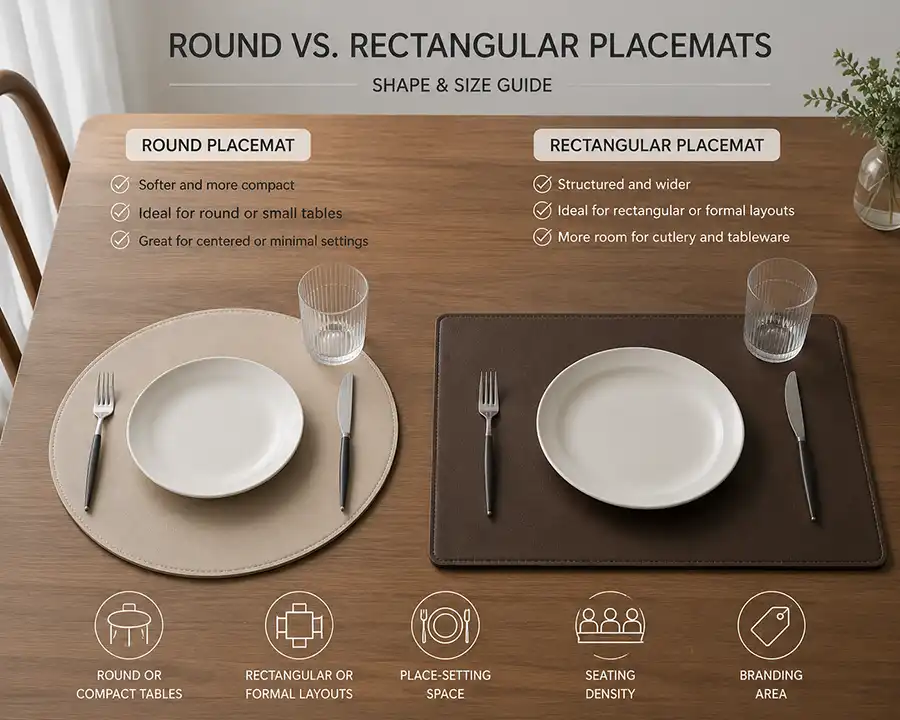



When comparing custom placemat suppliers, look beyond the unit price to material construction, production consistency, customization charges, packaging, delivery terms, and defect handling. A useful quotation identifies what you will receive, how production will match the approved sample, and which costs remain outside the quoted price.
Two suppliers can quote the same size, color, and logo while offering noticeably different products. One placemat may have a thinner construction, a different backing, or a less carefully finished edge. Those differences can be difficult to spot in a quotation and obvious once the goods reach your warehouse.
The practical question is whether the price covers the product your customers expect—and whether the supplier can repeat it.
Compare Quotes Based on the Same Placemat Specifications
Before comparing prices, send each supplier the same product brief. A reference photo helps communicate appearance, but it rarely explains the full construction.
Descriptions such as “premium leather” or “high-quality PU” leave too much open to interpretation. Ask the supplier to identify the surface material, backing, overall thickness, and edge treatment separately. If genuine leather is required, state that clearly rather than relying on the word “leather” alone.
A comparison sheet can expose differences that a price list hides.
| Item | What to confirm |
|---|---|
| Material | Surface material, supporting layers, and backing |
| Dimensions | Finished size, shape, and agreed tolerance |
| Thickness | Total thickness and acceptable variation |
| Appearance | Color, texture, sheen, and approved reference |
| Edges | Cut, painted, stitched, or another agreed finish |
| Branding | Logo method, dimensions, placement, and color |
| Packaging | Pieces per set, protective layers, labels, and cartons |
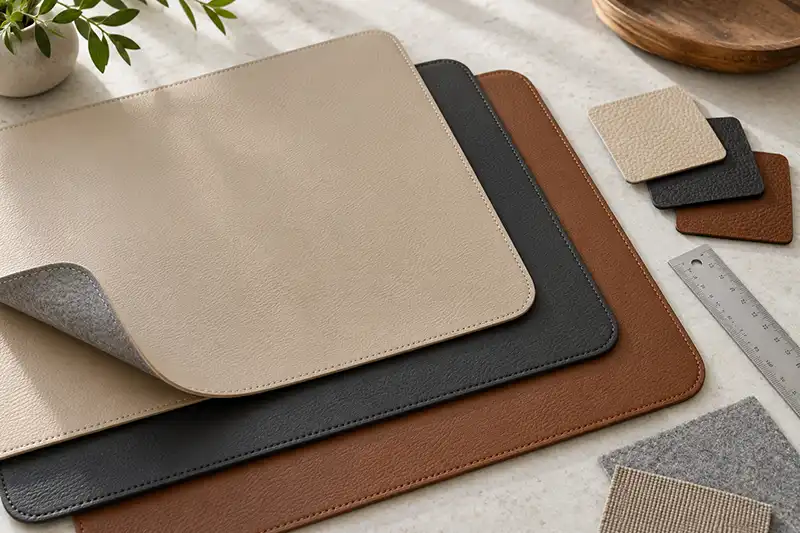
If one quotation excludes retail packaging and another includes it, the prices are not yet comparable. The same applies to logo tooling, sample charges, and freight.
If you are still deciding between constructions, our wholesale leather placemats buying guide provides a starting point for reviewing material and order requirements.
Check the Sample Under Real Dining Conditions
A photograph cannot tell you whether a placemat lies flat, feels comfortable at the edge, or cleans as expected.
Inspect the physical sample on the type of table surface your customers are likely to have. Look at it under ordinary room lighting as well as daylight. A surface that appears matte in a supplier’s photo may look noticeably glossy in a dining room.
For a wipe-clean product, follow the proposed care instructions and inspect the result. Watch for surface changes, residue around the logo, or moisture reaching exposed layers.
Heat resistance also needs a clear definition. Ask what temperature, contact time, and test conditions support any claim. A placemat described as heat-resistant should not automatically be treated as a trivet for cookware taken directly from a stove or oven.
Sample approval should establish a product your business can describe accurately.
Check Both Sides and the Edges of Reversible Leather Placemats
A reversible placemat needs two finished surfaces. Review the texture, color, logo orientation, and edge appearance with either side facing upward.
For example, when reviewing a reversible PU faux leather placemat, compare both color faces and the transition between them along the edge. A close-up of one surface leaves half the product unexamined.
Also check how the placemats look when stacked. Uneven outlines or inconsistent thickness can become more noticeable in a retail set than in an individual sample.
Ask How Production Will Match the Approved Sample
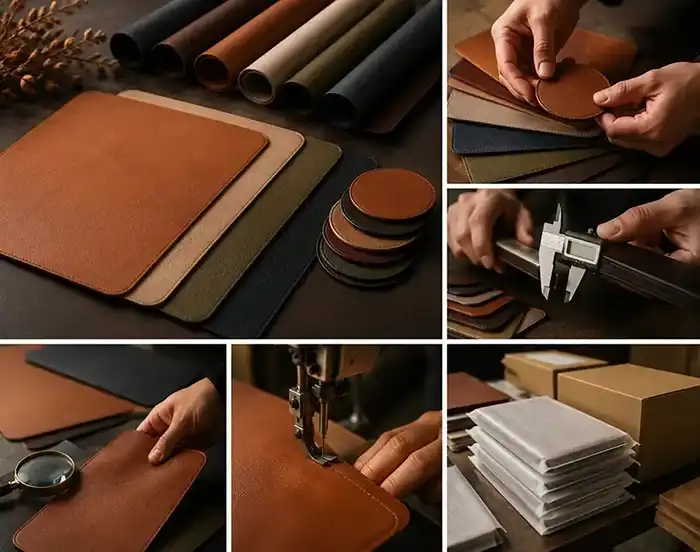
An approved sample establishes a reference. It does not explain how a larger order will be controlled.
Ask whether the sample uses the material and finishing process planned for production. If a material is temporarily unavailable, find out before approval rather than after the order has started.
Agree in writing on:
Which sample serves as the production reference.
How color and texture differences will be assessed.
Which dimensions and finishing details will be checked.
Whether material substitutions require approval.
How finished goods will be inspected before shipment.
For repeat orders, confirm that the original material reference remains available. A supplier may still offer “beige” even though the current material differs from the shade in your previous collection.
That matters when customers purchase additional sets months later.
Calculate the Cost of Receiving Sellable Goods
A low unit price can lose its advantage once packaging, shipping, inspection, and handling are included.
For comparison purposes:
Cost per sellable set = total order-related cost ÷ number of sets available for sale.
Order-related costs may include goods, setup charges, packaging, freight, import charges where relevant, inspection, and warehouse rework.
Consider a set that arrives with the wrong barcode or a retail sleeve that does not fit. The placemats may be acceptable, but your team still has to correct the packaging before the stock can be sold.
Ask suppliers to separate one-time charges from recurring charges. Logo tooling, custom cutting tools, and packaging setup may affect the first order differently from later purchases. Confirm what happens when the artwork, dimensions, or packaging changes.
Compare Delivery Schedules With the Same Starting Point
“Thirty days” is incomplete without a starting point.
Does production begin after the deposit, artwork approval, material confirmation, or approval of the final sample? Does the quoted period include packing and dispatch?
For a launch with a fixed date, work backward from the day the goods must be ready for sale. Allow time for inspection, transport, customs clearance where relevant, and warehouse receiving.
A useful schedule identifies dates for specification approval, material readiness, production completion, inspection, and dispatch. This makes delays easier to identify while there is still time to respond.
Agree on Defect Handling Before Ordering
Ask how to report a problem, what evidence the supplier requires, and how an accepted claim will be resolved.
Replacement goods, a credit, and a refund have different consequences for your business. Replacements added to a future order may work for a continuing collection. They may offer little help for a one-time seasonal promotion.
An agreed sample and written specification give both sides a fair reference when judging an issue.
Give Suppliers Enough Detail to Quote Accurately
When you contact us about custom placemat manufacturing, include your material preference, dimensions, quantity, logo artwork, packaging format, destination, and required delivery date.
If some choices remain open, identify them. Asking for two clearly defined material options produces a more useful comparison than asking several suppliers for their “best quality.”
A worthwhile quotation leaves you with a defined product, a complete cost, and delivery commitments your business can plan around.