
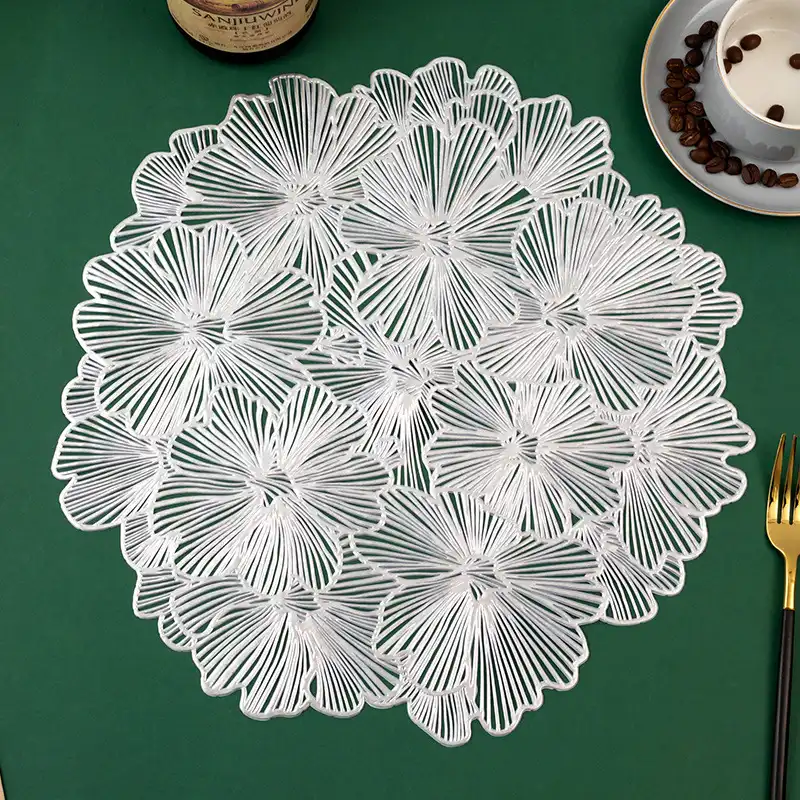
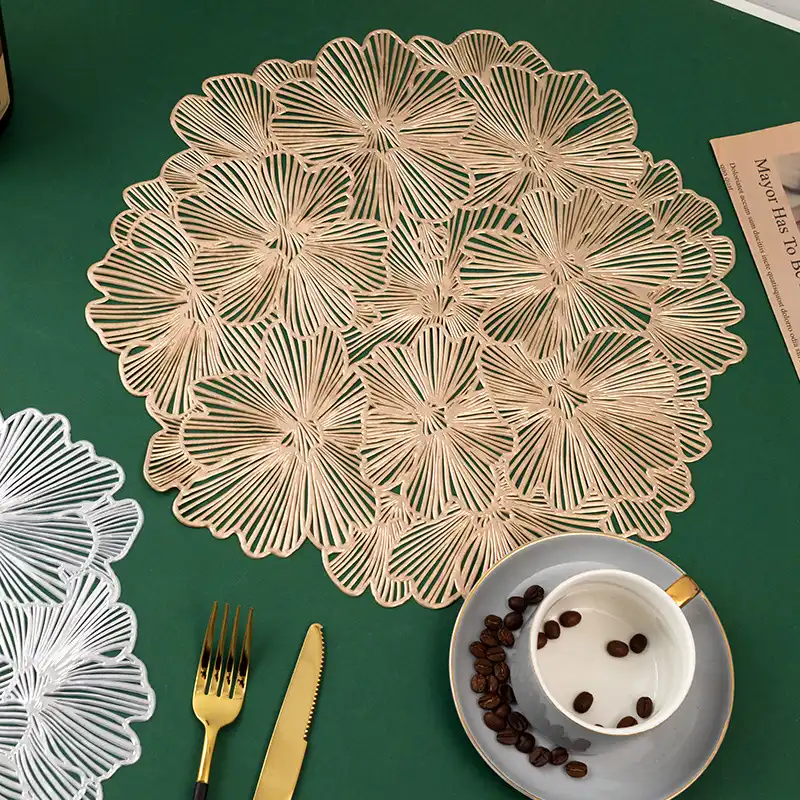
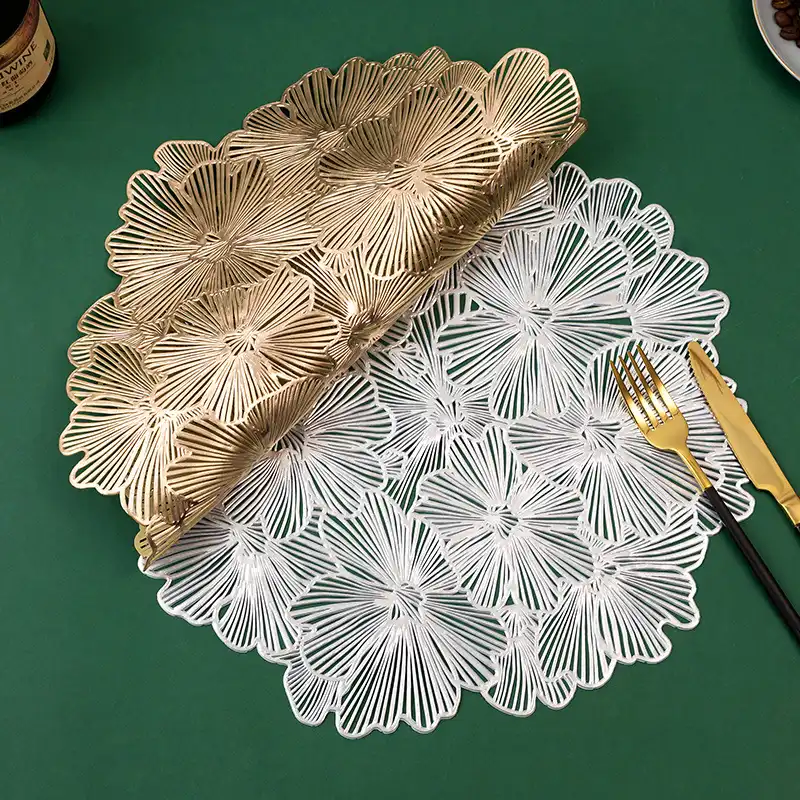
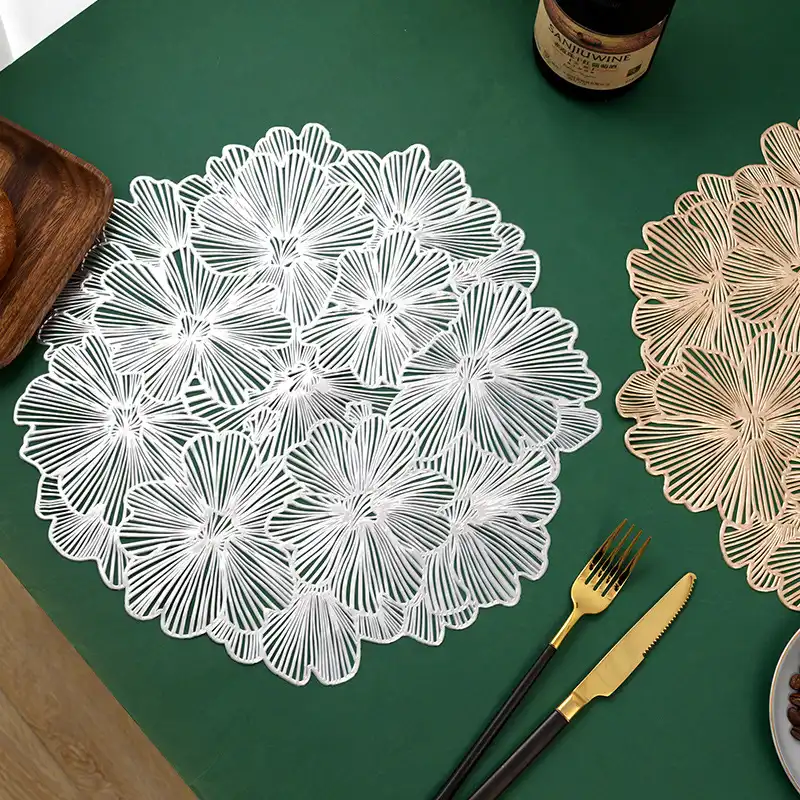
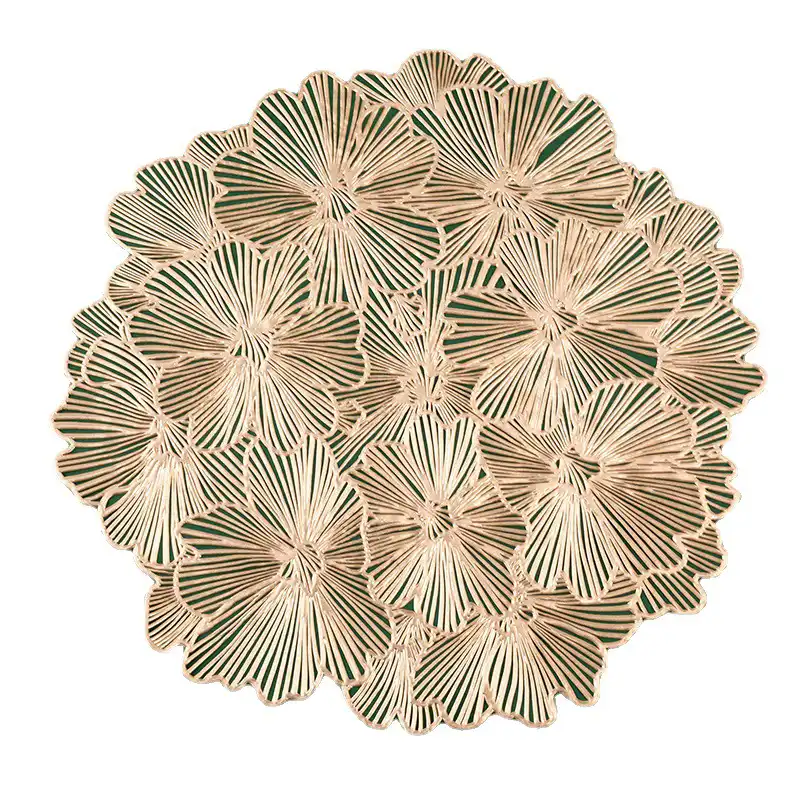
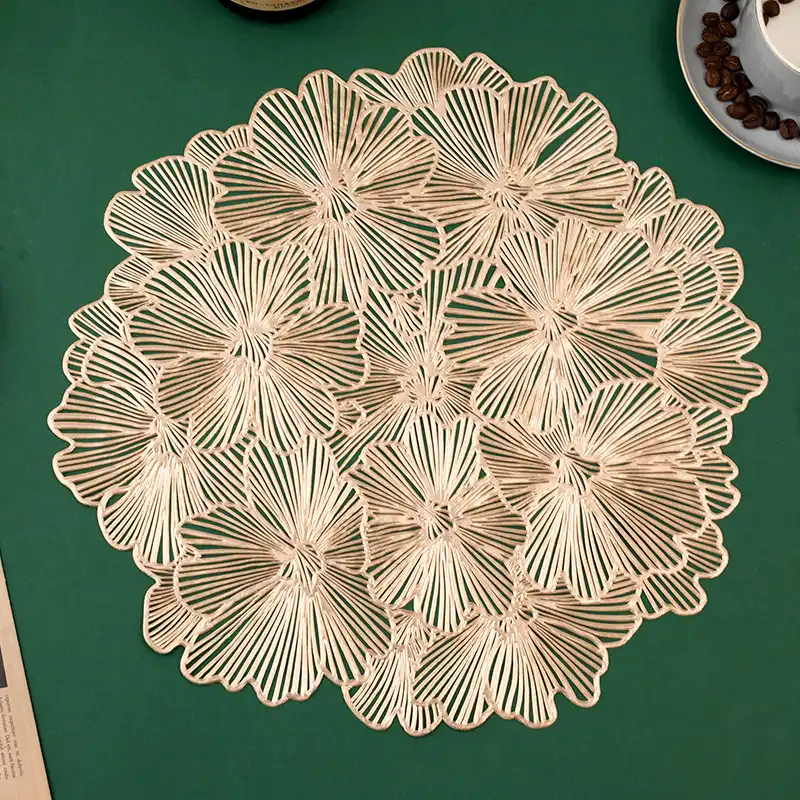
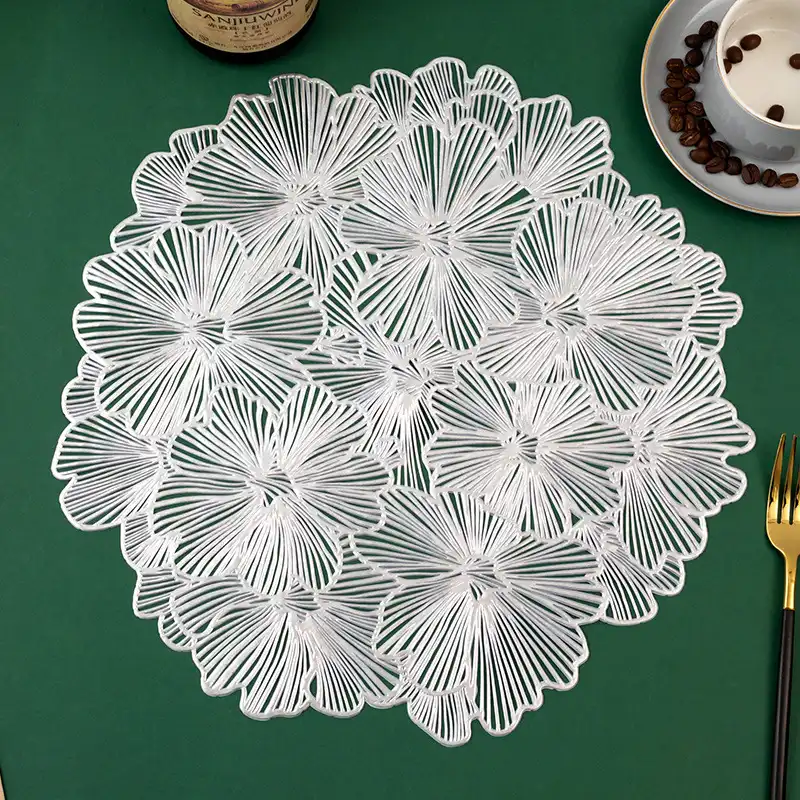
This is not a single oversized leaf repeated across a round mat. Multiple fan-shaped ginkgo leaves overlap and connect, forming an open botanical composition with a softly scalloped outer edge.
The tabletop remains visible between the fine leaf veins, so the background becomes part of the finished design. On dark green, black or walnut surfaces, the metallic leaves appear more pronounced; on pale tables, the same placemat creates a quieter and more delicate effect.
Product Details
| Item No. | T022 |
|---|---|
| Material | PVC |
| Shape | Round Botanical Cluster with Scalloped Leaf Edges |
| Standard Size | Approx. 38 cm Across |
| Surface Design | Overlapping Ginkgo Leaf Openwork |
| Construction | Flexible Open-Lattice PVC Structure |
| Color Options | Gold and silver |
| Care | Wipe or rinse gently, then dry flat before storage |
| Customization | Color, dimensions and selected product details may be reviewed for bulk projects |
A Cluster of Leaves Rather Than a Conventional Round Pattern
The placemat is assembled visually from many individual ginkgo leaves. Larger and smaller leaves overlap around the centre, while their fan-shaped edges create a more natural outline than a perfectly cut circle.
Fine open lines spread outward from the centre of each leaf. When several leaves meet, the changing line directions give the surface more movement and depth than a single repeated geometric pattern.
A plate placed in the centre covers part of the composition, but the surrounding leaves remain visible like a botanical frame. Smaller dessert plates, tea ware and side plates reveal more of the internal leaf arrangement, while larger dinner plates create a simpler outer border.
The approximately 38 cm footprint should be reviewed together with the intended plate. Oversized charger plates may conceal much of the design, and closely spaced dining positions may cause neighboring leaf edges to overlap.
The Table Surface Becomes the Second Color
The open spaces are not empty defects. They are an intentional part of the design, allowing the tabletop or table linen beneath the mat to appear between the metallic leaf veins.
This creates different visual results without changing the placemat itself. A gold mat on dark green produces a rich botanical contrast, while the same gold finish on cream linen appears warmer and more restrained.
Silver works naturally with gray stone, black glass, white porcelain and cooler interiors. Gold creates stronger warmth against dark wood, navy, forest green and other deeper surfaces.
Buyers should therefore approve the color on the actual table or cloth planned for the project. Product images taken on one background cannot fully represent how the openwork pattern will appear in another environment.
Botanical Table Solutions Built Around the Openwork Design
Modern Dining Rooms with Dark Tabletops
Dark green, black, navy and walnut surfaces provide strong contrast beneath the metallic leaves. Instead of adding several printed decorations, the openwork mat supplies one clear botanical feature while allowing the original table color to remain visible.
This works particularly well with white or dark ceramic plates, simple glassware and restrained cutlery. The setting gains detail without becoming crowded.
Tea Rooms and Smaller Plate Service
Tea cups, dessert plates and small serving dishes leave more of the leaf cluster exposed than a full dinner plate. Guests can still see the individual ginkgo shapes, fine veins and changing open spaces around the tableware.
The format can suit tea rooms, hotel lounges, bakery cafés and dessert service where the placemat contributes directly to the presentation rather than disappearing beneath a large plate.
Wedding and Event Table Styling
Gold can support warm evening settings, festive dinners and botanical wedding themes. Silver offers a cooler direction for contemporary venues, white table linen and more restrained event palettes.
The open construction allows the tablecloth color to show through, so event planners can change the overall effect by combining the same metallic mat with different linen colors.
Several samples should be arranged across the actual table before approval. The 38 cm footprint, guest spacing and scalloped leaf edges determine whether each dining position remains visually separate.
Decorative Bases for Menus and Table Displays
The placemat can also be placed beneath a small vase, menu stand, table number, gift tray or lightweight seasonal arrangement. In these applications, the overlapping leaves remain more visible than they would beneath a large dinner plate.
Do not use it beneath an open flame, an unprotected candle or cookware taken directly from a stove or oven.
Retail Botanical Collections
Gold and silver allow retailers and tabletop brands to present two distinct moods using the same recognizable ginkgo composition. The design can support dining, entertaining, wedding and seasonal display collections without relying on a conventional printed leaf pattern.
Project note: Confirm the plate diameter, visible leaf area, tabletop color, seat spacing and room lighting before approving the final version.
Practical Limits of the Openwork Structure
The metallic PVC resists routine contact with moisture, but the complete placemat is not a sealed waterproof barrier. Water, coffee, sauces, crumbs and fine residue can pass through the openings and reach the surface below.
After a spill, lift the placemat and clean both sides as well as the tabletop. This is especially important on unfinished wood, lacquered furniture and other moisture-sensitive surfaces.
The many open lines may create useful friction on some dry tables, but actual grip depends on the table material, surface finish, dust and moisture. A physical sample should be tested when a hotel, restaurant or event project requires a particular level of stability.
Sharp cutlery should not be dragged across the openwork details. The placemat is intended to sit beneath tableware, not to function as a cutting board or a protective layer for knife work.
Cleaning Between the Ginkgo Leaf Veins
Shake away loose crumbs before wiping. Routine marks can usually be removed with a soft damp cloth or sponge and a small amount of mild detergent.
When food residue becomes caught between the open lines, rinse the mat briefly and clean gently with a soft brush. Follow the direction of the leaf veins rather than scraping across the openings.
Avoid abrasive pads, stiff brushes, sharp tools, bleach, alcohol and strong solvent-based cleaners. These may scratch the PVC, distort fine sections or reduce the clarity of the metallic-looking surface.
Do not leave the placemat soaking for an extended period. Machine washing and dishwashers are not recommended.
Dry the front, reverse and open sections completely before stacking. The flexible mat may be loosely rolled for short-term handling, but flat storage is preferred to preserve the outer leaf shapes.
Normal dining plates, bowls, cups and warm serving ware may be placed on the mat. Use a separate heat-resistant trivet beneath pots, pans and dishes taken directly from a stove or oven.
Wholesale Development and Sample Review
This product should be approved as a combination of metallic color, openwork density and background surface. Selecting gold or silver alone does not determine the complete table effect.
Gold and Silver Finish Selection
Gold creates a warmer and more ceremonial direction, while silver appears cooler and more contemporary. Alternative metallic tones may be reviewed according to order quantity, material availability and production feasibility.
Final approval should take place under the lighting and on the tabletop planned for the project because reflections and background contrast can change the visible color.
Diameter and Leaf Composition
The standard size is approximately 38 cm across. Alternative dimensions may be discussed for compact tea tables, dessert presentations, larger tableware or decorative displays.
Changing the overall size also changes the scale of the leaves, the width of the open lines and the amount of pattern visible around a plate. Custom dimensions should be evaluated through a complete sample rather than confirmed from a diameter alone.
Logo Application on an Open Botanical Surface
Branding is more limited than on a solid PVC placemat. Fine lettering placed across the open leaves may break apart or lose clarity.
A simple mark may be reviewed within a planned solid area or near a suitable outer section, subject to artwork evaluation and sample testing. Large central branding is likely to be covered by the plate and may compete with the ginkgo design.
Bulk Orders for Hospitality and Retail Projects
Wholesale and bulk orders can be reviewed for hotels, restaurants, tea rooms, wedding suppliers, event companies, distributors, tabletop retailers and homeware brands.
For quotation, provide the estimated quantity, preferred metallic color, required size, intended application, logo artwork when applicable and delivery destination.
Repeat orders should reference the approved sample and confirmed specification so that the leaf arrangement, opening size, metallic tone, dimensions and outer edge remain consistent.
Sample Confirmation Before Production
A physical sample can be used to evaluate the finished size, color, openwork consistency, flexibility, outer leaf shape, flatness and appearance against the intended tabletop.
Final production should follow the approved sample and confirmed product specification. Customization applies to the placemat itself; custom packaging is not included.
Metallic Ginkgo Leaf Openwork PVC Placemat Frequently Asked Questions
Is this one large ginkgo leaf or a group of leaves?
It is formed from multiple overlapping ginkgo leaves. The different leaf sizes and positions create an approximately round botanical cluster with a naturally scalloped outer edge.
What does openwork mean on this placemat?
The leaf pattern contains real openings rather than being printed on a completely solid sheet. The tabletop or tablecloth remains visible through the fine leaf veins.
Is the placemat completely waterproof?
No. The PVC material resists routine moisture, but liquid can pass through the open sections. Clean both the placemat and the table underneath after spills.
Will a 38 cm placemat fit a standard dinner plate?
It fits beneath many standard dinner plates while leaving part of the surrounding ginkgo design visible. Large charger plates may cover most of the leaves, so sample testing is recommended.
Which finish works better, gold or silver?
Gold generally creates a warmer and more decorative appearance, especially on dark green, navy and wood surfaces. Silver provides a cooler, cleaner effect with gray, white, black and modern table settings.
How should the open leaf pattern be cleaned?
Remove loose crumbs, wipe with a soft damp cloth and use mild detergent when necessary. A soft brush can help clean between the leaf veins. Rinse briefly and dry both sides completely.
Can hot cookware be placed directly on the placemat?
It may be used beneath normal dining plates, cups, bowls and warm serving ware. Pots, pans and cookware taken directly from a stove or oven require a separate heat-resistant trivet.
Can the color, size or logo be customized for wholesale orders?
Color and dimensions may be reviewed for bulk projects. Logo application depends on the openwork structure and artwork because fine details may not reproduce clearly across the leaf openings. Final options require sample approval.